
What is the mirror effect: why every relationship is a reflection of you? If you have survived more than a few failed relationships, you probably have a list of reasons why they ended.
Maybe your first partner was a terrible communicator. Maybe your second partner was emotionally unavailable. Maybe your third partner was controlling. It is incredibly easy to look at the wreckage of our past and confidently point the finger at the other person.
But if you keep finding yourself in the same painful dynamics, having the same arguments with completely different people, you have to stop and ask a very difficult question.
Are you the common denominator?
This is the hardest pill to swallow in human psychology. It is much easier to play the victim than it is to look at our own shadows. But if you want to stop hurting and start building a real, unshakable partnership, you must understand the mirror effect: why every relationship is a reflection of you.
In my new book, The Mirror Effect: You’re the Common Denominator, we tear down the illusion that your partner is your problem. We explore how your external world is simply a physical manifestation of your internal world.
If you are tired of repeating the same toxic cycles, here are 5 brilliant truths you must understand about how your relationships are reflecting your own unhealed wounds.

1. What is the Mirror Effect?
Before we can fix the patterns in your love life, we have to define exactly what is happening behind the scenes.
So, what is the mirror effect?
The mirror effect is the psychological and energetic reality that the people around you—especially your romantic partners—are constantly reflecting your own subconscious beliefs back to you. The traits that trigger you the most in your partner are almost always the exact traits you refuse to acknowledge within yourself.
If you are furious that your partner is “too needy,” the mirror is asking: Where are you secretly desperate for attention, but too ashamed to ask for it?
If you are constantly annoyed that your partner is “lazy,” the mirror is asking: Where are you refusing to give yourself permission to rest?
Your partner is not just a random person doing annoying things. They are a walking, talking mirror. Once you learn to ask, “What is this reflecting about me?” instead of attacking them, your entire life will transform.
2. We Are the Common Denominator in All of Our Relationships
Let’s look at your romantic history again. Think about every person who has broken your heart, crossed your boundaries, or let you down.
What is the single, undeniable thread connecting all of those experiences?
We are the common denominator in all of our relationships.
When a relationship fails, the ego immediately wants to protect itself. It says, “If they would have just listened to me, we would be happy.” But if you keep dating emotionally distant people, year after year, it is not bad luck. It is a biological tracking system.
Your nervous system is drawn to people who match your internal frequency. If you do not believe you are worthy of unconditional love, your brain will literally seek out partners who will treat you poorly, simply because it feels “familiar” and validates your internal belief.
You cannot fix this by trying to pick better partners. You can only fix it by fixing your internal belief system. When you realize you’re the common denominator, you take your power back. You no longer have to wait for them to change; you just have to change yourself.
3. What We Project, We Tend to Receive
Your mind operates like a movie projector. You carry old film reels full of your past traumas, childhood fears, and deeply rooted insecurities.
When you get close to a romantic partner, you turn the projector on. You shine your old fears directly onto them. If you research the psychological concept of projection, you will find that we often accuse our partners of the exact things we are secretly feeling ourselves.
This is a universal law: what we project, we tend to receive.
If you constantly project suspicion onto your partner—always checking their phone, accusing them of lying, and expecting them to cheat—you will eventually push them away. You will create the exact abandonment you were so terrified of.
If you project anxious, desperate energy into the room, your partner will subconsciously feel suffocated and start to pull back. What we project, we tend to receive. To change what you are getting out of your relationship, you must drastically change the energy you are putting into it.

4. Everyone and Everything is Your Mirror
While my book focuses heavily on romantic partnerships, this principle does not stop at the edge of your bed.
The profound truth is that everyone and everything is your mirror.
Your boss who constantly micromanages you? They are a mirror reflecting your own lack of boundaries.
Your children who refuse to listen? They are a mirror reflecting your own internal chaos and lack of emotional regulation.
Even your bank account is a mirror reflecting your deeply held beliefs about your own self-worth and abundance.
When you truly grasp the mirror effect: why every relationship is a reflection of you– you stop being a victim of circumstance. You start viewing every single annoying, frustrating, or painful interaction as a massive, flashing neon sign pointing directly at the areas where you still need to grow.
5. How to Clean the Mirror
So, how do we use this information to actually fix our relationships?
If you are constantly asking yourself, “Are you the common denominator?“ and the answer is yes, the solution is radical self-accountability.
You cannot fix your reflection by smashing the mirror. Yelling at your partner to change will never work. You must clean the mirror by changing the source—which is you.
The next time your partner triggers you, follow this protocol:
- Pause for 60 Seconds: Do not react. Do not yell. Close your mouth and breathe.
- Ask the Hard Question: Ask yourself, “What is this reflecting about me? Why does this specific action hurt me so badly?”
- Own the Wound: Say to your partner, “I am feeling very triggered right now. It is not your fault; my old wound is just flaring up.”
When you do this, you completely disarm the argument. You step out of the blame game and into conscious co-creation.
Your Ultimate Guide to Transformation
Understanding what is the mirror effect, is just the very first step. Applying it to your daily life, especially when you are angry, tired, or stressed, requires a clear blueprint.
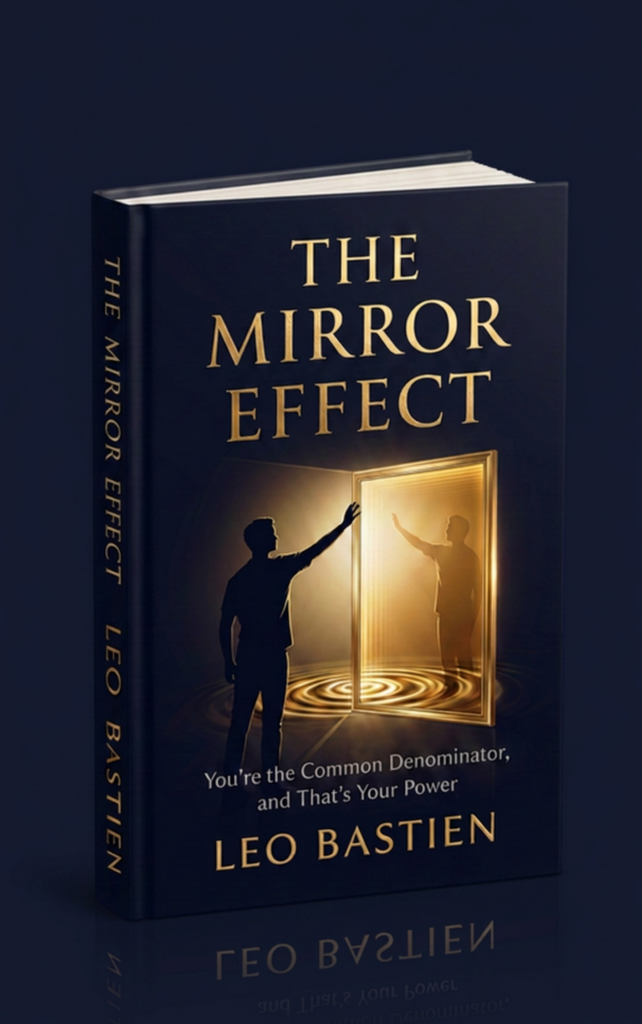
That is exactly why I wrote The Mirror Effect: You’re the Common Denominator. This book is a complete system for using your relationship as a tool for your own transformation. It will teach you how to stop projecting, how to take your power back, and how to build a love that feels safe, secure, and deeply connected.
Do not spend another year fighting the same ghosts.
Grab your copy of the book today, and subscribe to our YouTube channel, @theloversmindset, where we break down exactly how to apply the mirror effect: why every relationship is a reflection of you in real-time, every single week!
Frequently Asked Questions (FAQ)
What is the mirror effect?
The mirror effect is the psychological concept that your external world is a reflection of your internal state. In relationships, it means that the traits, behaviors, and patterns that trigger you in your partner are almost always reflecting your own unhealed wounds or subconscious beliefs about yourself.
Are you the common denominator in your failed relationships?
Yes. If you look at all of your past failed relationships, the only person present in every single one of them is you. We are the common denominator in all of our relationships, which means if you keep experiencing the same painful patterns with different people, the root of the problem lies within your own belief system.
What does it mean when they say everyone and everything is your mirror?
It means that this concept goes beyond just romantic partners. Your friends, your boss, your children, and even your financial situations are all reflecting your internal boundaries, emotional regulation, and self-worth back to you.
Is it true that what we project, we tend to receive?
Absolutely. If you project anxiety, suspicion, and fear onto your partner, you will likely create a dynamic of defensiveness and distance. By changing your internal projection to trust and security, you change the energetic frequency of the relationship, attracting a much healthier dynamic.