
If you’re reading this, you’re probably struggling in your relationship. What do you mean by mirror effect in relationships?
Maybe not catastrophically. Maybe your relationship just doesn’t feel the way you thought it would. Maybe you keep having the exact same argument, over and over, and you simply cannot figure out how to fix it. Maybe you feel unseen, unappreciated, or you’re quietly wondering if you picked the wrong person.
When we hurt, our immediate instinct is to point a finger.
It is human nature. We want to say, “You are making me feel this way. You are doing this wrong. If you would just change, everything would be better.”
But what if I told you that your partner isn’t actually the problem? What if your relationship isn’t broken? What if it’s exactly what you need right now?
What if everything you’re experiencing—the pain, the fights, the deep emotional triggers—is exactly what you need to grow?
This might sound crazy. But your partner’s behaviors, their habits, their words—none of that is the root issue. The real issue is happening inside your own mind.
Your partner is a mirror.
And you have been blaming the reflection instead of looking at what it is showing you.
For three years, I documented my long-distance relationship journey on YouTube. Thousands of people watched as I fell in love across 400 miles, figured out how to commit despite massive obstacles, and eventually married and built our blended family in New Jersey.
People connected with my story. They said things like, “Your love gives me hope,” and “If you can make it work long-distance, so can we.”
But when I stepped back and actually analyzed what made our relationship work—what transformed our connection from a struggle into a partnership, from fear into deep trust—I realized something shocking:
None of it was about her. It was all about me.
Every single time I felt triggered, disconnected, or afraid in our relationship, it wasn’t actually about her behavior. It was about what her behavior was reflecting to me about myself.
She wasn’t the problem. She was the mirror.
This is the premise of The Mirror Effect. It is the core teaching of my new book, The Mirror Effect: You’re the Common Denominator, and it is about to change how you see your partner forever.
To help you break out of the blame cycle, here are 7 powerful truths about the mirror effect in relationships.
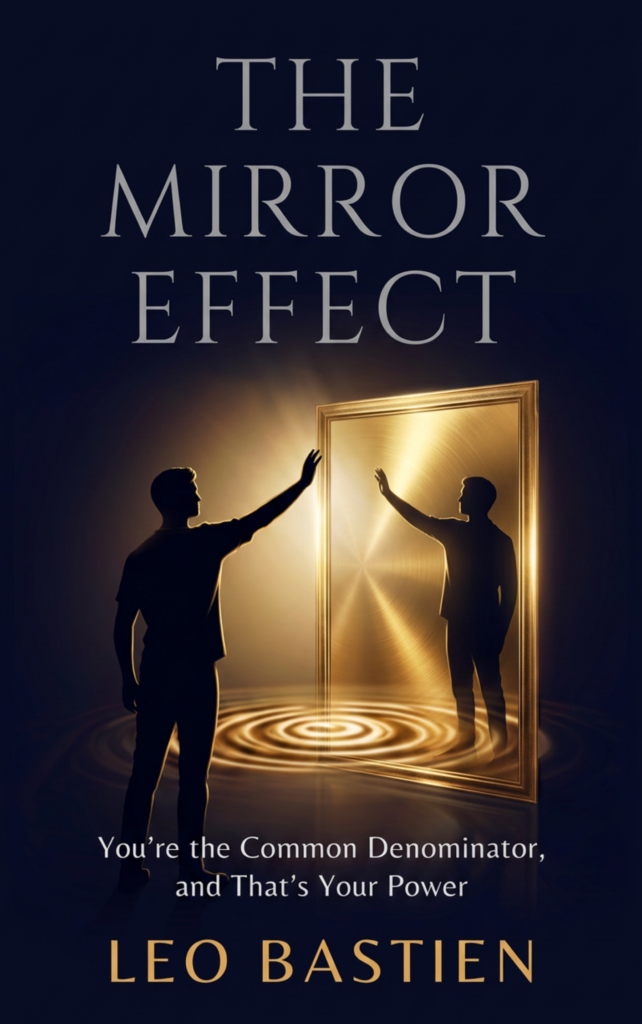
1. You Are the Common Denominator
Let me start with a hard question: What do all of your past relationships have in common?
Think about it. Every relationship that didn’t work out. Every time you felt hurt, misunderstood, or like you couldn’t break through to your partner. Every connection that eventually fell apart and left you brokenhearted.
What is the common thread?
You might say they were all bad communicators. You might say they were all emotionally unavailable, or they all took you for granted.
But here is the incredibly uncomfortable truth: The only constant in every single one of those relationships is you.
You’re the common denominator.
When a relationship fails, our ego desperately wants to protect us. It tells us stories. It says, “If they would just listen to me, we’d be happy. If they would just try harder, we could make it work. If they would just change, everything would be fine.”
But if you keep finding yourself in similar situations with entirely different people—if you keep having the exact same type of conflict, feeling the same type of pain, and playing the same victim role—the universe is trying to show you something.
You are not unlucky. You are not cursed in love. You are being shown a mirror. And right now, you have a massive choice: You can keep blaming the reflection, or you can finally look at what it is reflecting.
2. The Architecture of the Projector
So, what does it actually mean to experience the mirror effect in relationships?
Think of your mind like a massive movie projector. Inside that projector, you carry miles of old film reels. These reels are made up of your past wounds, your childhood fears, and your deepest, hidden beliefs about your own self-worth.
When you get close to someone, you turn the projector on. You shine these old reels directly onto your partner. And this is where what psychologists call projection happens: You see your own unresolved, painful feelings, but you genuinely believe they belong to the person standing in front of you.
This is where the trouble starts. This is The Projection Game.
Let’s say you grew up with a parent who was highly critical. You learned at a very early age that love meant constant judgment. So now, when your partner offers feedback—even gentle, loving, helpful feedback—your nervous system registers it as a mortal danger. You interpret their words through the thick lens of your old wound.
Your partner might just be saying, “Hey, I noticed you seemed really stressed about work today. Do you wanna talk about it?”
But because your projector is running, what you actually hear is: “You’re a failure. I’m judging you.”
So, you get defensive. You snap at them. You build an emotional wall and create massive conflict out of nowhere. And your partner is left entirely confused, standing there saying, “I was just asking if you wanted to talk.”
But you weren’t actually fighting with your partner. You were fighting with your past.
This is the mirror effect in relationships in full action. Your partner is showing you, right in this exact moment, the exact places where you still need to heal. They are revealing the moments where your past is still running the show.
And they are not doing it on purpose. They are just being themselves. They are just existing. And their simple existence is triggering your deepest patterns.

3. You Attract What You Need to Heal
Here is one of the most painful, yet liberating, realizations you will ever have in your life: You are attracting exactly what you are ready to heal.
Many people constantly ask, “Why do I keep attracting the same partner?“
If you keep ending up with people who are emotionally distant, it is not a coincidence. If you keep choosing people who are controlling, it is not bad luck. If you keep attracting people who are unavailable, dismissive, or hyper-critical—it is because your subconscious mind is desperately trying to heal something.
Your nervous system remembers your old wounds. And it will stubbornly keep picking the exact same type of person until you finally learn the lesson that person is trying to teach you.
If you do not know how to set healthy boundaries, you will continue to attract people who walk all over you. You will keep picking them, over and over, until the pain gets so bad that you finally learn how to say no. Once you learn that lesson and heal that specific part of yourself, the pattern stops permanently.
You stop attracting the same painful partner because you have finally outgrown the lesson. You have upgraded your internal software.
This is exactly why I kept attracting emotionally unavailable women before Sasha. My own emotional unavailability—the massive walls I had built around my own heart—was magnetizing me toward women with similar walls. We recognized each other’s frequencies. We locked together in our own defense mechanisms.
And we would have stayed stuck there forever, repeating the same toxic cycle, if I hadn’t recognized the pattern and done the deep inner work.
4. What You See in Them Is in You
In Chapter 4 of my book, we cover a principle that is very hard for the ego to swallow: What you see in them is in you.
The mirror effect in relationships guarantees that the traits you despise the most in your partner are almost always reflections of the traits you refuse to acknowledge within yourself.
If you are constantly enraged by your partner’s “laziness,” take a step back and look in the mirror. Are you actually mad at them, or are you furious that you never give yourself permission to rest? Are you projecting your own toxic burnout onto them because they have the courage to sit on the couch and do nothing?
If you are triggered by your partner being “too loud” or taking up too much space in social settings, look inward. Were you taught as a child that you had to be quiet, small, and invisible to be loved? Are you angry at them, or are you angry that you lost your own voice?
Your partner is simply acting out the unintegrated shadow parts of your own personality. They are giving you a front-row seat to your own subconscious.
5. The Mirror is Your Greatest Teacher
Here is what most people miss entirely: Your partner is not your enemy. They are not purposely trying to hurt you or trigger your nervous system.
They are your greatest teacher.
Every single trigger is a profound invitation. Every moment your partner pushes your buttons, they are holding up a massive mirror to the dark corners of your heart that you have been actively ignoring.
When you reframe your love life this way, everything changes.
Instead of thinking, “Why does my partner always do this to me?” you start asking a completely different set of questions:
- “What is this showing me about myself?”
- “What part of me is being reflected right now?”
- “What deeply held belief about my own worth is being triggered?”
And suddenly, the fight does not feel personal anymore. It feels like highly valuable information.
Your partner becomes your most valuable mirror. Not because they are perfect, but because they are close enough that their behavior actually penetrates your thick emotional defenses.
A stranger at the grocery store cannot trigger you the way your partner can. A colleague at work cannot push your buttons like someone you love. Because true intimacy requires vulnerability. And vulnerability means your partner gets to see all of you—including the parts that are still broken and bleeding.
6. Taking Absolute Ownership of Your Experience
Here is the ultimate secret to mastering the mirror effect in relationships: When you take absolute ownership of your feelings, you become totally untouchable.
If you realize that your partner cannot actually make you angry—that your anger is solely your own response to your own interpretation of the event—you win.
If you realize that your partner cannot make you feel worthless—that your worthlessness is a heavy belief you have been carrying around since childhood—you win.
You are the boss of your own brain. Your partner’s behavior is just data. What you choose to do with that data is entirely, 100% up to you.
Now, let me be very clear: This does not mean you tolerate or ignore disrespectful behavior. It does not mean you stay in abusive or toxic situations. It means you stop giving your partner absolute power over your internal emotional state.
When you stop expecting your partner to behave perfectly so that you can feel happy, you set them free. You let them just be a human being. And when they are free to be a human—messy, imperfect, triggered, and flawed—the love flows so much more easily.
You stop being their judge. You start being their lover.
7. Transforming the Relationship by Transforming Yourself
This psychological shift is not easy. It goes against everything we see in Hollywood movies, read in romance novels, and hear in love songs. But it is the absolute only way to build a real, lasting, unshakable partnership.
If this resonated with you—if you are exhausted by having the same fight, and you are finally ready to step up and own your reflection—you are ready for the full system.
I wrote The Mirror Effect: You’re the Common Denominator to give you the exact blueprint for transformation.
This book isn’t about generic communication skills or finding out your love languages. It’s about fundamentally changing how you see your relationship—and in doing so, transforming the relationship itself.
Inside the book, we cover all 22 principles of this journey. We teach you exactly how you and your partner co-create the dynamics you’re experiencing. We give you the specific practices that will transform your relationship by transforming you.
Are you ready to stop blaming the mirror and start changing your life?
Take Action: Sign up for our free 7-Day Mirror Work Challenge today.
Get your copy of The Mirror Effect here: You’re the common denominator.
Subscribe to our YouTube channel: Follow @theloversmindset for free, weekly video teachings on these exact psychological frameworks.
Frequently Asked Questions (FAQ)
What does it mean that my partner is a mirror?
The mirror effect in relationships means that your partner reflects aspects of yourself back to you. Sometimes they reflect the qualities you admire, and sometimes they reflect the negative beliefs, insecurities, or behaviors you haven’t accepted within yourself. When they trigger you, they are almost always showing you an unhealed part of yourself.
How do I know what my partner’s mirror is showing me?
The next time your partner triggers you, you must pause before reacting. Ask yourself: “What am I actually upset about? Is this about their literal behavior, or is this about a deep belief I have about my own self-worth?” The answer often reveals the hidden wound the mirror is showing you.
Can my partner still be wrong even if I’m responsible for my reaction?
Absolutely. Your partner can behave badly AND you can be responsible for how you respond to it. The mirror effect doesn’t mean your partner isn’t accountable for their actions—it means you are accountable for your own emotional experience and how you choose to process the event.
What if my partner doesn’t understand the Mirror Effect?
You don’t need both people to understand the psychology for it to work. When you change your internal response and stop projecting, the entire dynamic of the relationship shifts. Your partner will feel the massive difference in your energy, even if they haven’t read the book or don’t understand the concept.
Isn’t this victim-blaming?
No. Taking responsibility for your part isn’t blaming yourself—it is empowering yourself. You cannot control your partner’s actions, but you have absolute control over how you respond. That is where your true power lives.