You expect to feel lonely when you are single, navigating a breakup, or living alone in a new city. But the most profound, agonizing isolation happens when you are sharing a home, a life, and a bed with someone you love. If you are feeling lonely in a relationship, you are experiencing a total collapse of your shared energetic frequency. It is the chilling realization that physical proximity does not equal emotional intimacy.
The deepest loneliness is not the absence of people; it is the absence of an aligned, shared frequency with the person sitting right next to you.
Quick Answer (Key Takeaways):
- The Paradox of Proximity: Feeling lonely in a relationship happens when the daily logistical routines (bills, chores, schedules) completely overwrite the emotional connection of the partnership.
- The Subconscious Warning: Often, this waking loneliness is first signaled by the subconscious mind through vivid, stressful dreams about distance, abandonment, or strangers.
- The Metaphysical Disconnect: Love alone is not enough to sustain a partnership; love must be actively translated into a shared daily architecture and nervous system regulation.
- The Solution: You cannot fix energetic drift with a massive argument. You must rebuild the connection through micro-rituals, subconscious dream decoding, and the Safe-Sharing protocol.
The Metaphysics of Feeling Lonely In A Relationship
When a couple first falls in love, their energetic frequencies naturally harmonize. You talk for hours, you intuitively understand each other’s moods, and you feel entirely “seen.” This is a state of peak metaphysical alignment.
However, as the relationship matures, the heavy burden of modern survival sets in. You take on demanding careers, financial responsibilities, and perhaps children. As the stress builds, your individual nervous systems go into “survival mode.” When two people are operating in survival mode, their frequencies become chaotic and guarded.
According to leading research in attachment theory and marital psychology, prolonged stress without emotional repair leads directly to chronic isolation. You stop sharing your inner world because it feels too exhausting.
Gradually, over months or years, you have less time for each other, less to say, and less true connection. You transform from passionate lovers into highly efficient roommates. Understanding this mechanical “slow drift” is the first step to healing. If you are feeling lonely in a relationship, it does not automatically mean your partnership is doomed or that you chose the wrong person. It simply means the static has overpowered the signal.
5 Shocking Truths About Why This Happens
To fix the distance, you must identify exactly what is blocking the signal. Here are the five subconscious and metaphysical truths about why feeling lonely in a relationship occurs, even when there is no obvious abuse or betrayal.
1. Love is Hidden Behind the “Logistical Ego”
Relationships start with love, but love is incredibly fragile when exposed to the daily grind. The most common reason for feeling lonely in a relationship is that love gets overshadowed by judgment, fear, and exhaustion.
Your ego’s job is to protect you. When you are tired, your ego builds a wall. If your partner forgets to do the dishes, your exhausted ego doesn’t say, “They must have had a hard day.” It says, “They don’t respect my time.” Over the years, these tiny, ego-driven judgments create a massive wall of resentment. The love is still there, but it is buried under a mountain of logistical grievances.
2. You Miss the Micro-Bids for Connection
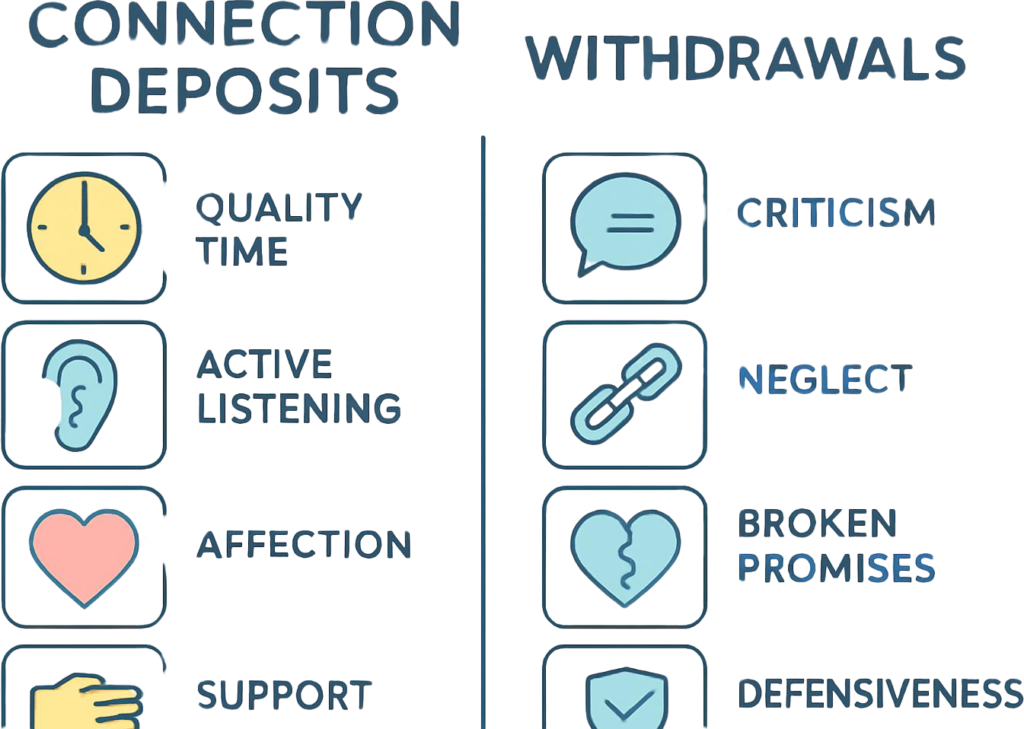
Isolation does not happen because you stopped taking lavish vacations; it happens because you stopped looking up from your phone. Throughout the day, we make small “bids” for connection. A sigh after reading an email. Sharing a meme. Asking a random question.
When you ignore these bids, your partner’s subconscious registers a micro-rejection. If you are feeling lonely in a relationship, both of you have likely spent the last six months unintentionally ignoring each other’s bids, starving the relationship of its required daily energy.
3. Your Dreams Are Sounding the Alarm
Long before you consciously admit that you are feeling lonely in a relationship, your subconscious mind will try to warn you. When you sleep, your defensive ego shuts down, and your brain processes your emotional state through visual metaphors.
If you are experiencing dreams where you are lost in a shifting house, wandering through a crowded mall, unable to find your partner, or screaming but no sound comes out, your mind is literally rendering your waking isolation. The loneliness has infiltrated your REM cycle.
4. Asymmetrical Metaphysical Growth
Sometimes, feeling lonely in a relationship happens because one person has fundamentally shifted their frequency. If you spend three years diving into personal development, mindfulness, spirituality, or new career ambitions, your energetic baseline changes. If your partner remains completely static, a frequency gap opens up. You are speaking a new language that they have not yet learned, leading to a profound sense of isolation.
5. The Hollywood Expectation Trap
Nowadays, people are constantly bombarded with unrealistic portrayals of relationships. Everyone on social media looks perfectly fulfilled. Movies do not show the patience, the boring Tuesday nights, or the awkward miscommunications. If you measure your real-world, messy human partnership against a curated digital fantasy, you will always end up feeling lonely in a relationship. You must learn to separate authentic energetic alignment from performative romance.

5 Metaphysical Fixes to Realign Your Frequency
If you are tired of the silence, you have to change the rules of engagement. Turning your phones off and having a face-to-face conversation is a positive start, but how you converse dictates whether you heal the gap or widen it. Here is the exact blueprint to stop feeling lonely in a relationship.
Step 1: The Baseline Frequency Audit
If you are experiencing deep isolation, you must first ask the hardest question: Is the baseline love still there? Sit in solitude and think back to the beginning. Write down exactly what their frequency felt like when you first fell for them. Look into your heart and see if that spark still exists beneath the resentment. If the love is there, the relationship is salvageable. If the love is entirely gone and replaced by contempt, you are dealing with a structural collapse, not just a frequency drift.
Step 2: Clear the Subconscious Static
Often, the reason you are feeling lonely in a relationship is that neither of you feels emotionally safe enough to be vulnerable. You must clear the static without triggering defensive arguments.
The best way to do this is by sharing your dream data.
- Dream Sharing For Couples: The Ultimate 7-Step Guide. The Midnight Bridge Technique: Connecting Through Shared Dreams. When you wake up, do not accuse your partner of ignoring you. Instead, share the emotion of a dream. “I had a dream last night that I was completely invisible, and I woke up feeling very sad.” Sharing a subconscious metaphor bypasses the waking ego. Your partner doesn’t have to defend themselves; they can simply comfort your emotions, instantly bridging the gap.
Step 3: Remove the Energetic Guilt
Try not to blame yourself for feeling this way. Relationships change over time and require active maintenance to blossom. Acknowledging that you are feeling lonely in a relationship is never a bad thing; it is the ultimate diagnostic tool.
Guilt operates on a very low energetic frequency. If you walk around feeling guilty that you aren’t happy, you will project a closed-off, defensive aura. Forgive yourself for the drift, and forgive your partner for the drift. You were both just trying to survive the stress of modern life.
Step 4: Institute the 10-Minute “No Logistics” Ritual
You cannot cure feeling lonely in a relationship if 100% of your conversations revolve around chores, children, and finances.
You must establish a daily connection ritual that is fiercely protected. Commit to 10 minutes every morning or evening where logistical talk is strictly banned. You can only discuss ideas, feelings, media, or your shared future. This ritual signals to the nervous system that your partner is your safe haven, not just your co-manager.
Step 5: The Safe-Sharing Disclosure
Healthy relationships thrive on being able to share openly and honestly. Resist the temptation to blame, but you must be straightforward. You cannot expect your partner to read your mind.
Use the Safe-Sharing framework to disclose your state. Do not say, “You make me feel lonely.” Say, “I have been feeling really lonely in our relationship lately, and I miss our connection. I want us to find our way back to each other.” Allow them the opportunity to step up, comfort you, and willingly participate in realigning your shared architecture.
Rebuilding the Bridge Together
The pain of feeling lonely in a relationship is terrifying, but it is not a death sentence for your love. It is a loud, unavoidable alarm bell from your subconscious mind demanding that you pay attention to your shared frequency.
When you stop treating the distance as a failure and start treating it as a mechanical breakdown of your connection habits, everything changes. You take the shame out of the equation. You realize that to get back in sync, you simply need to build better daily rituals, communicate past the defensive ego, and intentionally choose each other again, every single day.
Close the Emotional Gap Permanently: Reading about these concepts is the first step, but executing them when you are already feeling isolated requires a proven system. I built the-midnight-bridge to give couples the exact step-by-step blueprints to rebuild intimacy from the ground up. It includes the advanced Safe-Sharing scripts, the complete guide to decoding your subconscious dreams, and the exact daily rituals required to stop feeling lonely in a relationship and secure your metaphysical bond forever.
Why am I feeling lonely in a relationship?
Feeling lonely in a relationship usually occurs when a couple replaces emotional connection with logistical routine. When stress builds and daily “bids for connection” are ignored, partners can begin to feel like glorified roommates.
Is it normal to feel lonely while married?
Yes, it is incredibly common. The “slow drift” happens to almost all long-term couples. The key to a healthy marriage is not avoiding the drift, but establishing the communication rituals necessary to rapidly repair the distance.
How do you tell your partner you are feeling lonely?
Use “I” statements and focus on your emotional state rather than their failures. Say, “I have been feeling disconnected and lonely lately, and I really want us to spend some intentional time together this weekend.” Avoid accusatory statements like, “You never pay attention to me.”
Can a relationship survive emotional distance?
Absolutely. If the baseline love and respect are still intact, emotional distance can be completely reversed by introducing new daily rituals, practicing subconscious dream sharing, and committing to vulnerability.