
Have you ever ended a relationship, promised yourself you would never make the same mistakes again, and somehow found yourself having the same arguments with someone completely different?
Different face. Different personality. Different relationship.
But strangely familiar pain.
Maybe your first partner struggled to communicate. Your second was emotionally unavailable. Your third made you feel as though your needs were always too much.
And somewhere along the way, you began asking yourself a difficult question:
Why does this keep happening to me?
It’s tempting to believe that the answer is simply bad luck or choosing the wrong people. Sometimes, another person’s behavior genuinely is the problem.
But sometimes, there are patterns in how we interpret situations, communicate our needs, establish boundaries, or respond to emotional discomfort that deserve closer attention.
That’s where the mirror effect in relationships becomes a useful framework for self-reflection.
The mirror effect invites us to examine what our emotional reactions and recurring relationship experiences might reveal about our beliefs, expectations, fears, and unmet needs.
It doesn’t mean everything your partner does is your fault. It doesn’t mean you attract mistreatment or that changing yourself will automatically change another person.
Instead, it asks a more empowering question:
What can I learn about myself from this experience, and what can I choose to do differently?
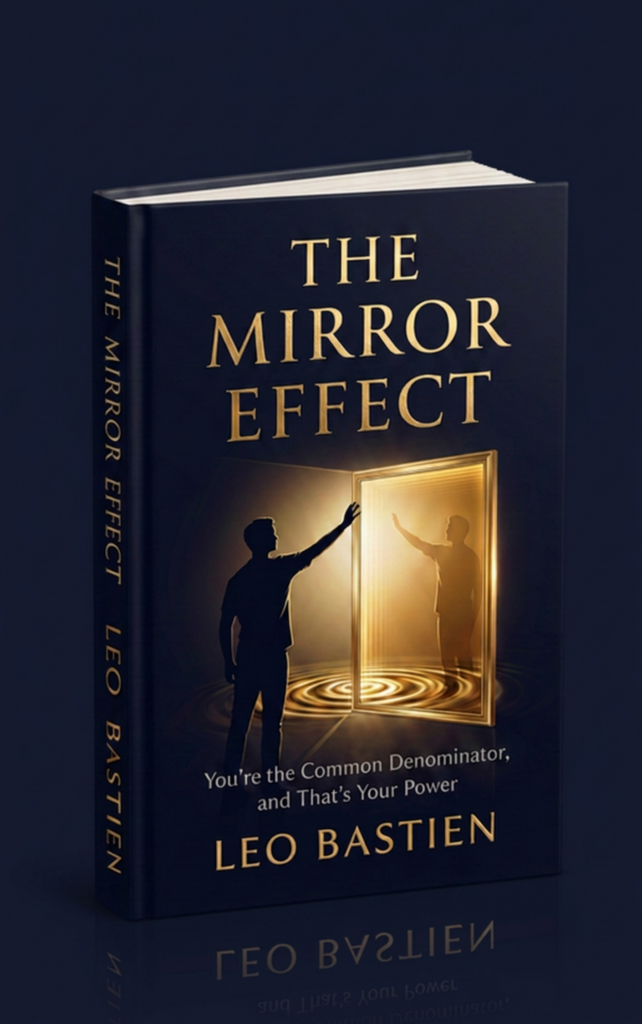
That question is at the heart of my book, The Mirror Effect: You’re the Common Denominator.
Because recognizing your role in a relationship isn’t about accepting blame for everything that goes wrong.
It’s about understanding the difference between what you can influence, what you can change, and what you should never have to tolerate.
Let’s explore five important insights that can help you recognize recurring patterns, develop healthier emotional responses, and build relationships grounded in mutual respect, accountability, and genuine love.

1. What Is the Mirror Effect in Relationships?
Before we can fix the patterns in your love life, we have to define exactly what is happening behind the scenes.
So, what is the mirror effect?
The mirror effect is the psychological and energetic reality that the people around you—especially your romantic partners—are constantly reflecting your own subconscious beliefs to you. The traits that trigger you the most in your partner are almost always the exact traits you refuse to acknowledge within yourself.
If you are furious that your partner is “too needy,” the mirror is asking: Where are you secretly desperate for attention, but too ashamed to ask for it?
If you are constantly annoyed that your partner is “lazy,” the mirror is asking: Where are you refusing to permit yourself to rest?
Your partner is not just a random person doing annoying things. They are a walking, talking mirror. Once you learn to ask, “What is this reflecting about me?” instead of attacking them, your entire life will transform.
2. Why Do We Repeat Relationship Patterns?
Let’s look at your romantic history again. Think about every person who has broken your heart, crossed your boundaries, or let you down.
What is the single, undeniable thread connecting all of those experiences?
We are the common denominator in all of our relationships.
When a relationship fails, the ego immediately wants to protect itself. It says, “If they had just listened to me, we would be happy.” But if you keep dating emotionally distant people, year after year, it is not bad luck. It is a biological tracking system.
Your nervous system is drawn to people who match your internal frequency. If you do not believe you are worthy of unconditional love, your brain will literally seek out partners who will treat you poorly, simply because it feels “familiar” and validates your internal belief.
You cannot fix this by trying to pick better partners. You can only fix it by fixing your internal belief system. When you realize you’re the common denominator, you take your power back. You no longer have to wait for them to change; you just have to change yourself.
3. How Projection Can Affect Relationships
Your mind operates like a movie projector. You carry old film reels full of your past traumas, childhood fears, and deeply rooted insecurities.
When you get close to a romantic partner, you turn the projector on. You shine your old fears directly onto them. If you research the psychological concept of projection, you will find that we often accuse our partners of the exact things we are secretly feeling ourselves.
This is a universal law: what we project, we tend to receive.
If you constantly project suspicion onto your partner—always checking their phone, accusing them of lying, and expecting them to cheat—you will eventually push them away. You will create the exact abandonment you were so terrified of.
If you project anxious, desperate energy into the room, your partner will subconsciously feel suffocated and start to pull back. What we project, we tend to receive. To change what you are getting out of your relationship, you must drastically change the energy you are putting into it.

4. What Your Emotional Triggers Can Teach You
While my book focuses heavily on romantic partnerships, this principle does not stop at the edge of your bed.
The profound truth is that everyone and everything is your mirror.
Your boss who constantly micromanages you? They are a mirror reflecting your own lack of boundaries.
Your children who refuse to listen? They are a mirror reflecting your own internal chaos and lack of emotional regulation.
Even your bank account is a mirror reflecting your deeply held beliefs about your own self-worth and abundance.
When you truly grasp the mirror effect– why every relationship is a reflection of you– you stop being a victim of circumstance. You start viewing every single annoying, frustrating, or painful interaction as a massive, flashing neon sign pointing directly at the areas where you still need to grow.
5. How to Break Unhealthy Relationship Patterns
So, how do we use this information to actually fix our relationships?
If you are constantly asking yourself, “Are you the common denominator?“ and the answer is yes, the solution is radical self-accountability.
You cannot fix your reflection by smashing the mirror. Yelling at your partner to change will never work. You must clean the mirror by changing the source—which is you.
The next time your partner triggers you, follow this protocol:
- Pause for 60 Seconds: Do not react. Do not yell. Close your mouth and breathe.
- Ask the Hard Question: Ask yourself, “What is this reflecting about me? Why does this specific action hurt me so badly?”
- Own the Wound: Say to your partner, “I am feeling very triggered right now. It is not your fault; my old wound is just flaring up.”
When you do this, you completely disarm the argument. You step out of the blame game and into conscious co-creation.
Ready to Understand Your Relationship Patterns?
Understanding what the mirror effect is: the mirror effect is just the very first step. Applying it to your daily life, especially when you are angry, tired, or stressed, requires a clear blueprint.
That is exactly why I wrote The Mirror Effect: You’re the Common Denominator. This book is a complete system for using your relationship as a tool for your own transformation. It will teach you how to stop projecting, how to take your power back, and how to build a love that feels safe, secure, and deeply connected.
Do not spend another year fighting the same ghosts. Explore The Mirror Effect ebook
Grab your copy of the book today, and subscribe to our YouTube channel, @theloversmindset, where we break down exactly how to apply the mirror effect: why every relationship is a reflection of you in real-time, every single week!
Frequently Asked Questions (FAQ)
What is the mirror effect?
The mirror effect is a self-reflection framework that encourages people to examine how their beliefs, emotional experiences, and expectations influence their relationships. It doesn’t mean that everything a partner does is a reflection of your internal state.
Why do I keep experiencing similar relationship problems?
Recurring patterns can have several explanations, including communication habits, attachment experiences, expectations, boundaries, compatibility, and partner choices. Identifying these patterns can help you make more informed decisions.
Does being the common denominator mean I’m responsible for failed relationships?
No. Being present in every relationship doesn’t mean you’re responsible for everything that happens. Each person is accountable for their own behavior. Self-reflection helps you recognize the choices and responses you can influence.
Is psychological projection real?
Yes. Psychological projection is a recognized concept involving attributing one’s own feelings or characteristics to others. However, not every disagreement, suspicion, or emotional reaction is projection.
How can I stop repeating unhealthy relationship patterns?
Begin by recognizing recurring situations, examining your assumptions, communicating your needs, setting boundaries, and observing whether your relationships demonstrate mutual respect and accountability. Professional support may also help when patterns are persistent or distressing.