
Have you ever accused your partner of something, only to realize later that the problem might have started with your own fears?
Maybe your partner was unusually quiet one evening.
You immediately thought, “They’re losing interest in me.”
You asked what was wrong.
They said, “Nothing. I’m just tired.”
But you didn’t believe them.
You kept asking questions, searching for reassurance, and interpreting every response as proof that something was wrong.
By the end of the evening, you were arguing.
And the strange part?
Your partner really was just tired.
This is one way our internal fears can influence how we interpret a relationship.
In psychology, projection refers to attributing our own feelings, impulses, or characteristics to someone else, sometimes without realizing we’re doing it.
In romantic relationships, projection can contribute to misunderstandings, defensiveness, and recurring arguments.
But here’s an important distinction.
Not every uncomfortable feeling is projection, and not every concern about your partner is imagined.
Sometimes your partner really is behaving in a hurtful or dishonest way.
Understanding relationship projection psychology means learning to recognize the difference between what is happening, what you’re assuming, and what you may be bringing into the situation emotionally.
Let’s explore seven signs of projection in relationships and what you can do about them.
1. YYou Assume Your Partner Feels What You’re Feeling
Imagine you’ve been feeling insecure about your appearance.
You look in the mirror and criticize yourself.
Later, your partner casually says, “You look tired today.”
Immediately, you think:
“They don’t find me attractive anymore.”
But did your partner actually say that?
No.
Your own insecurity may have influenced how you interpreted their comment.
Projection can happen when we attribute feelings or judgments we struggle with ourselves to another person.
For example, someone who feels ashamed of a mistake might assume their partner is judging them harshly, even when their partner hasn’t expressed that judgment.
What can you do?
Separate the observation from your interpretation.
Ask yourself:
- What did my partner actually say or do?
- What meaning did I attach to it?
- Is there evidence supporting my interpretation?
- Could there be another explanation?
Instead of saying, “You think I’m unattractive,” try:
“When you said I looked tired, I felt self-conscious. What did you mean?”
That small change creates room for clarification instead of accusation.

2. You Accuse Your Partner of Feelings You Haven’t Acknowledged
Sometimes we struggle to recognize emotions or impulses within ourselves.
We may find them uncomfortable, embarrassing, or inconsistent with how we want to see ourselves.
Psychological projection can involve attributing those unwanted feelings or characteristics to someone else.
For example, someone who feels jealous may repeatedly accuse their partner of being jealous.
Someone struggling with anger may insist that everyone around them is hostile.
And someone experiencing doubts about a relationship might become unusually preoccupied with whether their partner wants to leave.
These examples don’t prove projection is occurring.
But they offer opportunities for reflection.
What can you do?
Before confronting your partner, ask:
“Is this something I’ve been feeling myself?”
“Am I uncomfortable acknowledging that feeling?”
“What evidence do I have about my partner’s actual experience?”
You don’t have to criticize yourself for having difficult emotions.
The goal is to recognize them before turning assumptions into accusations.
3. You Interpret Neutral Behavior as Rejection
Picture this.
You send your partner a loving message.
An hour passes.
No reply.
Two hours.
Still nothing.
Your mind begins creating explanations.
“They’re ignoring me.”
“They don’t care.”
“Maybe they’ve met someone else.”
By the time your partner replies, you’re already upset.
But they were in a meeting.
This experience may involve anxious assumptions or sensitivity to rejection rather than psychological projection in the strict sense.
That distinction matters.
Not every relationship misunderstanding is projection.
Sometimes our expectations are shaped by past experiences, stress, or uncertainty.
What can you do?
Try separating three things:
The fact: My partner hasn’t replied for two hours.
The interpretation: They must be ignoring me.
The feeling: I feel anxious and disconnected.
Then ask whether your interpretation is supported by evidence.
If delayed communication is a recurring concern, discuss expectations directly.
For example:
“I understand you’re busy during work. Could we agree on a time to catch up in the evening?”
This is more constructive than assuming the worst.
4. You React More Strongly Than the Situation Seems to Require
Have you ever had a small disagreement that suddenly felt enormous?
Your partner forgets something you asked them to do.
You become intensely upset.
Later, you realize your reaction wasn’t only about the forgotten task.
It reminded you of years of feeling overlooked.
Past experiences can influence emotional reactions.
However, a strong emotional response doesn’t automatically mean you’re projecting.
Your reaction may reflect accumulated frustration, an unmet need, or a legitimate pattern of behavior.
The important question is whether you’re responding only to the present situation or also to something it reminds you of.
What can you do?
Try this four-part reflection:
- What happened?
- What emotion did I experience?
- What did I believe the situation meant?
- Does that belief fit the current evidence?
5. You Keep Having the Same Argument Without Understanding Why
Some couples have arguments that seem to repeat endlessly.
One partner feels criticized.
The other feels ignored.
One withdraws.
The other pursues the conversation more intensely.
Both become frustrated.
Eventually, the argument stops.
But nothing changes.
A week later, the same pattern returns.
Projection can sometimes contribute to these cycles, particularly when partners assume negative intentions or attribute their own uncomfortable feelings to each other.
But recurring conflict may also involve communication difficulties, unmet needs, incompatible expectations, or unresolved harm.
It’s important not to reduce every relationship problem to one psychological explanation.
What can you do?
Instead of focusing only on who started the argument, examine the sequence.
Ask:
“What usually happens right before we begin fighting?”
“What do I assume my partner means?”
“How do I typically respond?”
“What does my partner do next?”
“What could each of us change?”
Notice that last question.
A healthier relationship requires mutual accountability, not one person accepting responsibility for everything.
If the same conflicts continue despite genuine efforts to address them, couples counseling may help identify and change the pattern.
6. Healing is an Inside Job
You Confuse Self-Reflection With Self-Blame
This is where conversations about relationship psychology can become misleading.
You may have heard someone say:
“Your partner is simply a mirror of your inner world.”
Or:
“If you keep attracting the same kind of person, the problem must be you.”
These statements can sound empowering.
But taken literally, they can also be harmful.
You are responsible for your choices, boundaries, communication, and behavior.
You are not responsible for another person’s dishonesty, cruelty, manipulation, or abuse.
And experiencing mistreatment does not mean you subconsciously attracted or deserved it.
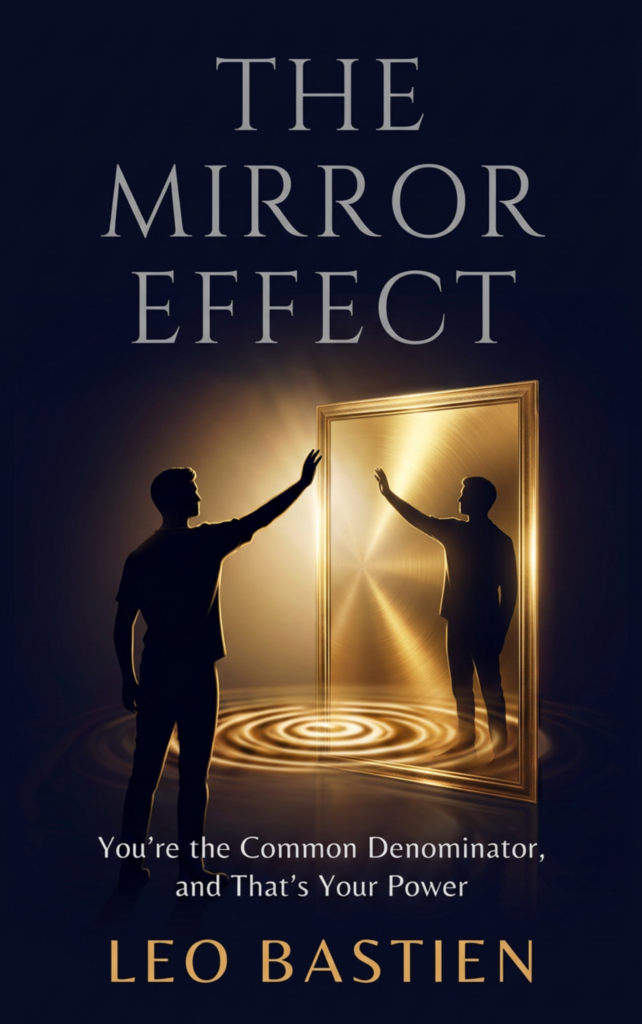
In my book, The Mirror Effect: You’re the Common Denominator, I explore the value of examining recurring relationship patterns.
But the most useful way to approach this idea is as an invitation to self-awareness—not as a scientific law that explains everything your partner does.
What can you do?
Ask yourself two separate questions:
What is mine to work on?
Perhaps your communication style, emotional regulation, expectations, or boundaries.
What belongs to my partner?
Their actions, honesty, accountability, and willingness to treat you with respect.
Both questions matter.
Self-awareness becomes more useful when it helps you distinguish your responsibilities from someone else’s.
For a broader exploration, read The Mirror Effect in Relationships: What It Reveals.
7. You Struggle to Separate Your Fears From the Evidence
Imagine your previous partner was unfaithful.
You were devastated.
Eventually, you entered a new relationship.
Your new partner has given you no clear reason to distrust them.
But whenever they mention a coworker, you feel anxious.
You wonder whether history is repeating itself.
Past betrayal can affect how safe we feel in future relationships.
That doesn’t necessarily mean you’re projecting in the clinical or psychological sense.
But it does show how previous experiences can shape our interpretations.
The challenge is learning to acknowledge those feelings without treating them as proof.
What can you do?
When fear appears, ask:
“Is this concern based on something happening now?”
“Or does it remind me of something that happened before?”
“What evidence would help me understand the situation more clearly?”
“Can I discuss this without accusing my partner?”
You might say:
“I’ve been feeling anxious because of something I experienced in a previous relationship. I know you aren’t responsible for that experience, but I’d like us to talk about what helps us both feel secure.”
Your partner can respond with empathy while still maintaining reasonable privacy and boundaries.
Trust grows through consistent behavior, not constant surveillance.
How to Stop Projecting Insecurities Onto Your Partner
Recognizing a pattern is useful.
But what do you do when you notice yourself making assumptions?
Try this five-step practice.
Step 1: Pause Before Reacting
If you’re emotionally overwhelmed, give yourself a moment before responding.
You might take a few slow breaths or ask for a short break.
The purpose isn’t to suppress your feelings.
It’s to avoid turning an untested assumption into an accusation.
Step 2: Identify the Actual Emotion
Ask yourself what you’re feeling.
Jealousy?
Fear?
Embarrassment?
Sadness?
Anger?
Naming the emotion may help you understand your reaction more clearly.
Step 3: Separate Facts From Interpretations
Write down what happened.
Then write down what you assumed it meant.
For example:
Fact: My partner wanted an evening alone.
Interpretation: They don’t enjoy spending time with me.
Feeling: I felt rejected.
These are three different things.
Recognizing the difference can help you respond more thoughtfully.
Step 4: Communicate Without Mind-Reading
Instead of saying:
“You don’t care about me anymore.”
Try:
“When we haven’t spent much time together, I start feeling disconnected. Could we plan some time for us?”
You’re expressing a need without claiming to know your partner’s thoughts.
Step 5: Look for Patterns Over Time
One misunderstanding doesn’t define your relationship.
But repeated assumptions, arguments, or emotional reactions may reveal something worth examining.
Consider journaling, discussing the pattern with your partner, or seeking support from a qualified mental health professional.
And remember:
Self-reflection should never become an excuse to tolerate repeated mistreatment.
Projection vs. Intuition: How Can You Tell the Difference?
This is a question many people struggle with.
You have a strong feeling that something is wrong.
But is it intuition, anxiety, projection, or a response to actual behavior?
There isn’t a simple test that can always tell you.
Feelings can be meaningful signals that deserve attention, but they aren’t necessarily reliable evidence about another person’s intentions.
Try looking at observable behavior.
Has your partner repeatedly broken promises?
Have they been dishonest?
Are they dismissing reasonable concerns?
Or are you mainly reacting to possibilities without supporting evidence?
You can take your feelings seriously while still checking the facts.
If you’re experiencing controlling behavior, intimidation, threats, or abuse, prioritize your safety rather than trying to reinterpret those experiences as your own projection.
Understanding Your Patterns Without Blaming Yourself
One of the most valuable parts of relationship growth is learning to recognize what you bring into a partnership.
Your expectations.
Your fears.
Your communication habits.
Your boundaries.
Your ways of responding to disappointment.
But healthy self-awareness doesn’t require believing that you cause every difficulty in your relationships.
It means recognizing what you can influence while holding others accountable for their choices.
That’s the distinction that makes personal growth useful.
And it’s a central theme of The Mirror Effect.
Ready to Explore Your Relationship Patterns?
If you keep finding yourself in familiar arguments or struggling to understand your emotional reactions, you may benefit from a more structured approach to self-reflection.
I wrote The Mirror Effect: You’re the Common Denominator to help readers examine recurring relationship patterns, develop greater self-awareness, and make more intentional choices.
The book explores personal responsibility, emotional habits, boundaries, and the ways our interpretations can influence relationships.
It’s not about blaming yourself for everything that goes wrong. It’s about recognizing the parts of your experience you can understand and change.
Explore The Mirror Effect:
You can also explore our other relationship articles and resources at The Lover’s Mindset.
Frequently Asked Questions (FAQ)
What is projection in a relationship?
Psychological projection involves attributing feelings, impulses, or characteristics of your own to another person. In relationships, it may contribute to misunderstandings when someone assumes their partner has feelings or motives that actually reflect their own internal experience.
What are examples of projection in relationships?
Examples may include attributing your own jealousy to your partner or assuming your partner is judging you because you’re struggling with self-criticism. However, similar behaviors can also arise from anxiety, misunderstandings, or real relationship problems.
How do I know if I’m projecting onto my partner?
Consider whether you’re attributing feelings or intentions to your partner without sufficient evidence, especially when those feelings resemble something you’re struggling to acknowledge in yourself. Reflection can help, but it isn’t always possible to identify projection with certainty.
Can projection ruin a relationship?
Repeated accusations, misunderstandings, and defensiveness can damage trust and emotional connection. Projection may contribute to these problems, although it is rarely useful to assume that projection explains every conflict.
How do I stop projecting insecurities in relationships?
Start by recognizing your emotions, separating facts from assumptions, asking clarifying questions, and communicating your needs without accusing your partner of hidden intentions. Professional support may help when the pattern is persistent or distressing.
Is every relationship problem a reflection of yourself?
No. Relationships involve two people with independent feelings, decisions, and responsibilities. Self-reflection can help you understand your reactions, but it does not make you responsible for another person’s harmful behavior.
Final Thoughts
The next time something your partner says or does triggers a strong emotional reaction, consider asking yourself a simple question:
“Am I responding to what happened, or to what I believe it means?”
Sometimes you’ll discover that an old fear has influenced your interpretation.
Sometimes you’ll realize that your partner’s behavior genuinely needs to change.
And sometimes both things may be true.
The goal isn’t to become someone who never feels jealous, insecure, angry, or afraid.
The goal is to understand those emotions well enough to respond with greater clarity.
Because healthier relationships begin when we learn to distinguish our fears from the facts—and take responsibility for what truly belongs to us.